Advertising, A Four-Step Strategy That Turns Clicks Into Customers
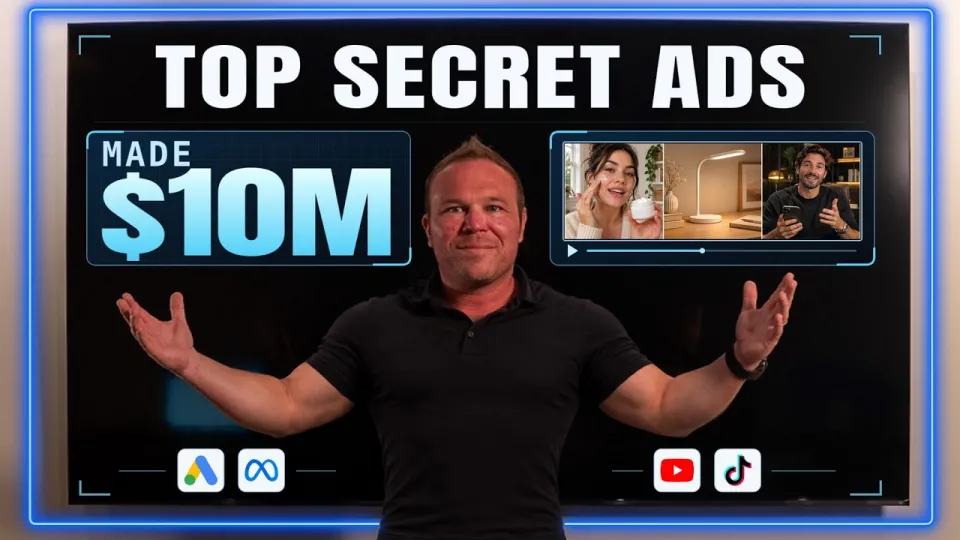
Video: $10M Advertising Strategy (Step-by-Step)
· based on the channel Brad Smith
Key takeaways
- Brad Smith of AutomationLinks manages roughly $3 million in monthly ad spend using this four-step advertising framework.
- New ad traffic should go to a blog post or video, not the homepage, so visitors get value before a sales pitch.
- The budget is split 60/40: most spend goes to cold traffic generation, the rest to retargeting people who already engaged.
- Retargeting should run across every platform a prospect touched, including Google, Facebook and YouTube.
- The funnel ends with a clear call to book a call or buy, backed by email follow-up for people who are not ready yet.
Advertising works best when you plan the follow-up before you spend more money on clicks. A visitor who clicks an ad, browses, and leaves is not a lost lead: they are a person who needs a second, third, and fourth touchpoint. The four-step advertising strategy Brad Smith of AutomationLinks uses to manage about $3 million a month in ad spend builds those touchpoints in a fixed order, and you can see how the agency structures client campaigns on its advertising agency page.
Why most advertising budgets leak at the homepage
Sending paid traffic straight to a homepage is the single most common way small businesses waste ad money. The homepage is built for everyone and therefore speaks to no one in particular, and a cold visitor arriving from a search or social ad has no context for what they are looking at. They scan, they bounce, and the click you paid for produces nothing.
The fix is not a bigger budget. It is a different destination. The strategy below assumes that the first click is only the beginning of a relationship, and that the real conversion happens after a series of small, low-friction commitments.
Step 1: Send new advertising visitors to a blog post or video
The first step is to route cold ad traffic to a piece of content that teaches something useful rather than to a sales page. A blog post, a tutorial, or a short video answers the question that made the person click in the first place, which builds trust before any offer appears.
This is where the "Nike shoe effect" comes in. Someone who tries on a pair of Nikes and walks away has not rejected the shoe; they are carrying the memory of it. A week later, when they are ready to buy, the brand they remember gets the call. Content does the same job for your business: it plants a memory that survives the moment the visitor leaves your site.
Once someone has consumed that content, they become retargetable. You can follow them across advertising platforms, including Google, Facebook, and YouTube, with a consistent message instead of a single impression that disappears.
Step 2: Get advertising traffic onto your email list
Retargeting ads are rented attention; an email list is owned attention. The second step converts anonymous visitors into named contacts by inviting them to join your newsletter through retargeting campaigns that give a clear reason to subscribe.
A practical sequence looks like this:
- A cold visitor lands on the blog post or video from Step 1.
- A retargeting ad follows them with a newsletter invitation.
- The opt-in page states exactly what subscribers will receive and how often.
- A welcome email arrives immediately to keep the relationship warm.
Email also protects you from rising ad costs. When platform prices climb, a list of people who already know your brand lets you keep selling without paying for every impression.
Step 3: Give people a real reason to opt in
The third step is the offer itself, and it has to be something the reader can actually use. A generic "subscribe for updates" rarely justifies handing over an email address; a checklist, template, calculator, or short guide does.
Useful criteria for the opt-in offer:
- It solves one specific problem in under 15 minutes.
- It is consumable immediately, without a sales call.
- It connects naturally to the paid product or service you sell.
- It is delivered on a landing page built for one action only, with no navigation distractions.
A landing page that asks for a single decision converts better than a page that asks for several. Every extra link is an exit.
Step 4: Get people to book a call or buy
By the fourth step, the prospect has read your content, joined your list, and received something useful. Now the ask is appropriate: book a call or complete a purchase. The call to action should be explicit, repeated in follow-up emails, and paired with a low-friction scheduling or checkout flow.
This is also where follow-up email sequences earn their keep. Many buyers are not ready on day one, and a sequence that mixes education with reminders keeps your business in the position the Nike analogy describes: the one they remember when the decision moment arrives.
How to split an advertising budget 60/40
Smith splits spend 60/40 between cold traffic and retargeting. The larger share goes to reaching new people, because a retargeting audience only exists if you keep filling the top of the funnel. The smaller share goes to following up with people who already engaged, where cost per conversion is typically lower.
The 60/40 split is a starting point, not a law. If your retargeting audience is small, shift more toward cold traffic until the pool grows; if your sales cycle is long, the retargeting share can rise. The principle is that both halves of the funnel need funding at the same time.
What the $10 million outcome actually depends on
Smith references a company that sold for more than $10 million, and the lesson is not the exit figure but the structure behind it: a predictable flow of new visitors, an owned list, a useful opt-in, and a clear path to purchase. None of those elements is expensive on its own; the compounding comes from running all four together.
To get started, define the content piece for Step 1, build the opt-in offer for Step 3, and set the 60/40 split before you increase spend. Measure each stage separately so you can see whether the leak is in traffic, opt-ins, or the final ask.
Conclusion
The four-step advertising strategy is a sequence, not a menu: content first, email second, a usable offer third, and a clear buying path last, all funded by a 60/40 split between cold traffic and retargeting. Its advantage is that it does not depend on a single platform or a single clever ad; it depends on remembering the visitor after they leave. Brad Smith, owner of AutomationLinks, walks through the full framework in the video breakdown above, including the funnel his own team runs. If you want help applying it to your business, reach out to the AutomationLinks advertising team.
Questions & answers
Why should advertising traffic go to a blog post instead of a homepage?
A homepage speaks to every audience at once, so a cold visitor from an ad has no clear reason to stay. A blog post or video answers the specific question that triggered the click, which builds enough trust for the visitor to accept a retargeting ad or an email invitation later.
What does the 60/40 advertising budget split mean?
Roughly 60% of spend goes to cold traffic that brings new people into the funnel, and 40% goes to retargeting people who already engaged. The ratio is a starting point: small retargeting audiences need more cold spend to grow, while long sales cycles can justify a larger retargeting share.
How do retargeting and email work together in this advertising strategy?
Retargeting ads bring a visitor back after they leave the site and point them to a newsletter opt-in. Email then carries the relationship forward with a useful offer and follow-up, so the business stays present without paying for every impression.
What makes a good opt-in offer for paid advertising?
It should solve one specific problem quickly, be usable immediately without a sales call, and connect to the product you sell. Delivering it on a single-purpose landing page with no navigation distractions keeps the visitor focused on one action.
Source: $10M Advertising Strategy (Step-by-Step) · Markdown version